SMPTE ST 2110 Routing and
NMOS Control Infrastructure
for Broadcast Engineers
The SMPTE ST 2110 standards suite specifies the carriage, synchronisation, and description of separate elementary essence streams over IP for real-time production, playout, and other professional media applications. Utah Scientific's ST 2110 routing infrastructure and NBOSS NMOS control solution give broadcast engineers the tools to implement, manage, and scale IP workflows — without abandoning the SDI reliability they've built their operations on.
Utah Scientific’s ST 2110 & NMOS Control Products
Utah Scientific’s ST 2110 product ecosystem covers every layer of IP broadcast infrastructure from native encapsulation and de-encapsulation inside the router chassis, to a purpose-built NMOS control layer that manages ST 2110 flows with the same ease as SDI. Every product is backed by the broadcast industry’s only no-fee 10-year hardware warranty.
UTAH-400 Series 2 Gateway Router — Best for: ST 2110 core routing with integrated SDI fallback
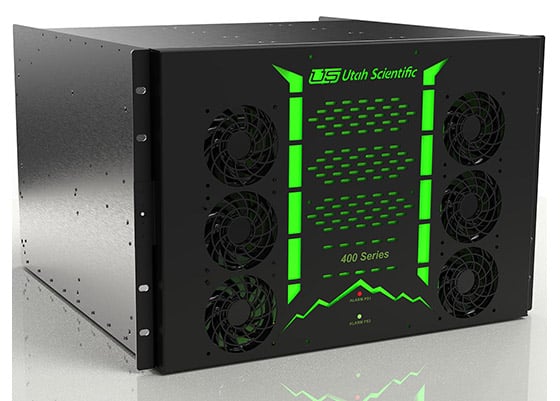
Native ST 2110 Routing Inside the SDI Chassis — No External Gateway Required
The UTAH-400 Series 2 Gateway Router delivers native SMPTE ST 2110 encapsulation and de-encapsulation within the router frame — maintaining a physical SDI connection for continuous signal flow with no downtime or signal path loss if the IP fabric encounters a disruption. Modern architecture reduces power consumption and rack space requirements by up to 25% compared to legacy systems, and the system is compatible with SC-4, SC-40, and SC-400 control systems and NMOS-compliant software for simplified workflow orchestration.
-
- Frame sizes 72×72 to 1056×1056 · hot-swappable I/O cards
- PTP compliant, clocking not required · four 25Gb SFP ports per PassThrough card
- NMOS IS-04/IS-05 compliant · no-fee 10-year warranty
NMOS Control Solution — Best for: Managing ST 2110 & SDI flows from a single control interface

Switch ST 2110 Flows as Easily as SDI — Utah Scientific's Native NMOS Control Layer
NBOSS is Utah Scientific’s software-based control solution designed to streamline the management of NMOS-compliant devices in hybrid SDI/IP environments — enhancing workflow efficiency and reducing operational costs, empowering facilities to build hybrid SDI/IP infrastructures with greater ease and reliability while expanding the utility of Utah Scientific’s existing hardware. NBOSS provides IS-04 discovery and IS-05 connection management, IS-09 system parameters and IEEE 1588 PTP awareness, enabling operators to switch ST 2110 flows as easily as SDI using Utah Scientific’s SC-4, hardware panels, Soft-LC, or Web Panel interfaces.
- AMWA NMOS IS-04, IS-05, IS-09 · IEEE 1588 PTP aware
- Compatible with SC-4 hardware panels, Soft-LC, and Web Panel interfaces
- Designed for Series 2 routers and On-Ramp devices
PassThrough Cards — Best for: Adding ST 2110 to an existing UTAH-400 Series 2 installation
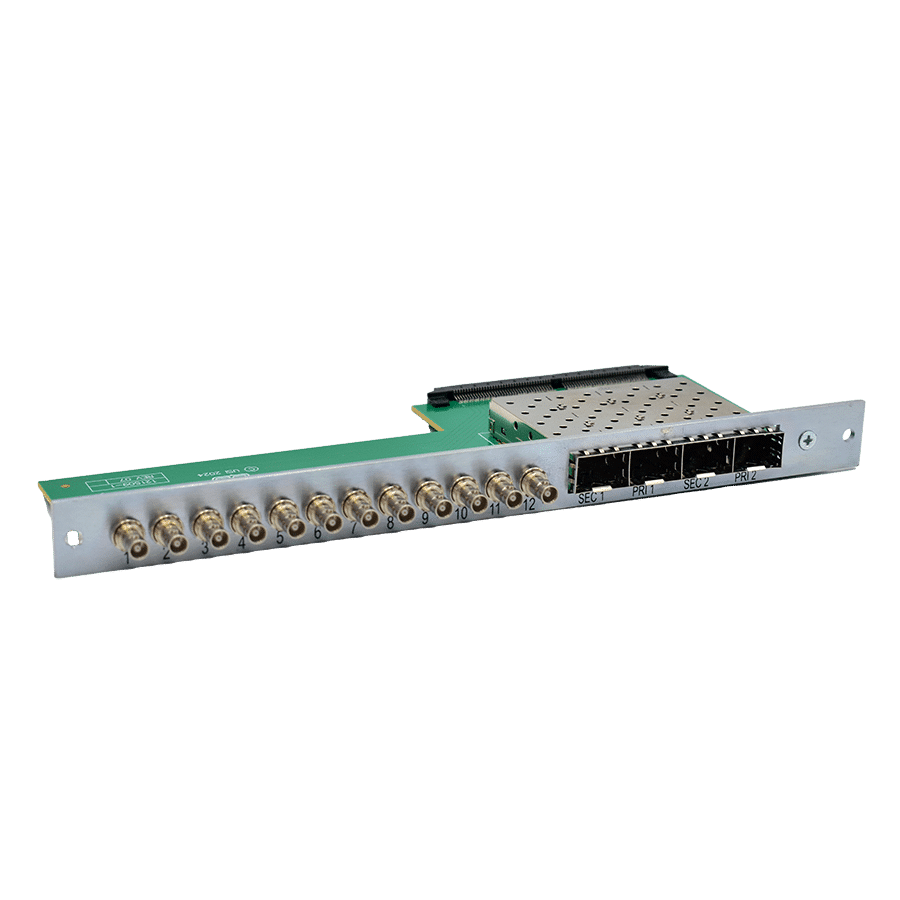
ST 2110 Encapsulation Inside Your Existing Series 2 Chassis — No New Hardware
The PassThrough card supports SMPTE ST 2110 controlled via NMOS, is PTP compliant with clocking not required, and uses four 25Gb SFP ports to carry bi-directional IP — inputs or outputs. Input configuration copies 12 SDI signals to 12 uncompressed IP streams; output configuration copies all 12 SDI outputs to 12 uncompressed ST 2110 IP video and audio signals. Slots directly into existing UTAH-400 Series 2 I/O card positions — no chassis replacement required. .
- Supports SMPTE ST 2022-6/8 and SMPTE ST 2110 · VLAN tagging · IGMP · AMWA IS-04, IS-05, IS-09
- 12 HD-BNC SDI ports · Four 25Gb SFP ports
- Input and output configurations available · No-fee 10-year warranty
On-Ramp— Best for: Adding ST 2110 to any Utah Scientific router — UHD-12G, UDS, or Series 2
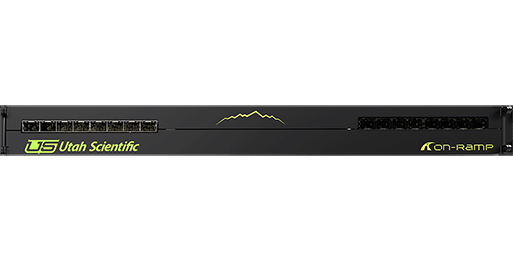
1RU ST 2110 Gateway for Any Utah Scientific Router — Modular, Hot-Swappable, Forward-Compatible
On-Ramp is Utah Scientific’s 1RU hybrid gateway and signal processing device that adds SMPTE ST 2110 encapsulation and de-encapsulation to any Utah Scientific router line. Five hot-swappable card slots, 16 SFP cages, and support for 12G UHD, 3G HD, and 1.5G SDI to ST 2110 conversion. NBOSS addresses customer demand for a more integrated and cost-effective way to manage Utah Scientific’s expanding product line, particularly the PassThrough Card and OnRamp devices — making On-Ramp a fully NBOSS-manageable ST 2110 gateway from day one.
- 1RU · five hot-swappable card slots · 16 SFP cages
- Supports single, double, or mixed encap/de-encap configurations
- NBOSS-manageable
One Control Interface. Every Signal Format.
FSDI and ST 2110 Together
_____________
The most common challenge broadcast engineers face when implementing ST 2110 isn’t the standard itself — it’s managing two separate control environments for two separate signal domains. SDI routing on one system. IP flows on another. Two interfaces, two training requirements, two operational contexts on every shift.
Utah Scientific’s architecture eliminates that split. NBOSS allows users to control NMOS devices directly from Utah Scientific’s SC-4 control system using a variety of interfaces, including hardware panels, Soft-LC panels, and Web Panel — the same interfaces operators already use for SDI routing. No parallel infrastructure. No separate NMOS management system to procure, configure, and maintain.
Whether you’re ready for full IP, staying with SDI, or operating in between, Utah Scientific’s solutions are built to support your workflow today — and for the next decade.

Inside Utah Scientific’s ST 2110 & NMOS Control Architecture
How SMPTE 2110, NMOS IS-04/IS-05, PTP timing, and SDI routing operate simultaneously under a single control panel.
- SMPTE ST 2110 — Separate Essences, Unified Timing:
Each ST 2110 stream is individually timed and can take different routes over the networked fabric to arrive via unicast or multicast at one or more receivers. Audio-video-data synchronisation using PTP clocks ensures accurate synchronisation of all streams regardless of how the packets were routed. Utah Scientific’s PassThrough cards and On-Ramp handle this natively inside or alongside the router chassis, without external processing hardware. - NMOS IS-04 — Automatic Device Discovery:
NBOSS provides IS-04 discovery — so every NMOS-compliant device on the network is automatically registered and visible to the control system on startup. Operators don’t manually configure IP endpoints; the registry handles it, and NBOSS surfaces those devices through Utah Scientific’s familiar control interfaces. - NMOS IS-05 — Connection Management: NBOSS provides IS-05 connection management, defining how ST 2110 flows are routed and switched between registered devices. From the operator’s perspective, routing an ST 2110 flow works the same as taking a crosspoint on an SDI router — same panel, same workflow, same muscle memory.
- NMOS IS-09 — System Parameters: NBOSS provides IS-09 system parameters, allowing NMOS nodes to obtain global configuration parameters across the entire ST 2110 system on startup — ensuring consistent behaviour across the infrastructure without per-device manual configuration.
- PTP Timing — IEEE 1588 with SDI Reference Coexistence:
NBOSS provides IEEE 1588 PTP awareness, and PassThrough cards are PTP compliant with clocking not required — meaning the system can synchronise ST 2110 streams without a dedicated external PTP grandmaster, while simultaneously supporting legacy analog Black Burst references for SDI infrastructure still in the signal chain. - SDI Safety Net:
The Gateway Router’s design maintains a physical SDI connection for continuous signal flow — if the IP control system or network fabric encounters a disruption, critical feeds remain live through the dedicated SDI path. This is not a software fallback — it is a hardware-level SDI path that operates independently of the IP fabric.

Built for Engineers Who Can’t Afford a Second Thought
About Reliability
Our clients choose Utah Scientific ST 2110 and NMOS control infrastructure for engineering precision, operational simplicity, and a manufacturer commitment that outlasts the technology cycle.
_____________
CEO Statement on NBOSS & IP Integration
“With NBOSS, we’re giving our customers a smarter, more streamlined way to manage NMOS devices within their new or existing Utah Scientific infrastructure. NBOSS simplifies hybrid workflows, reduces reliance on third-party systems, and makes our Series 2 routers and OnRamp devices even more versatile. This isn’t just a new control tool — it’s a foundational step toward full IP domain integration.”
– Brett Benson, CEO, Utah Scientific
Industry Recognition
“As a well-known provider of dependable, worry-free routers with the world’s best warranty, Utah Scientific was an easy choice to supply the routers for this value-added solution.”
– Peter Schut, Senior Vice President, Media Infrastructure, EVS
10-Year No-Fee Warranty
The broadcast industry’s only no-fee 10-year hardware warranty. Included with every Utah Scientific ST 2110 router. No annual fees. No support contract required. The only ST 2110 infrastructure manufacturer that backs its products for a full decade — because the IP transition takes time, and your investment should be protected through it.
Frequently Asked Questions
Common questions about SMPTE ST 2110, NMOS IS-04/IS-05 control, Utah Scientific's NBOSS solution, and ST 2110 infrastructure implementation — answered by our engineering team.
Still have questions?
Our application engineers can help you design and implement an ST 2110 and NMOS control architecture that fits your facility's timeline and infrastructure requirements.