
Utah-400 Series 2 Hybrid Enterprise Router
A Single Router Frame for SDI, IP, Audio, Fiber, and Analog
The UTAH-400 Series 2 is built around a hybrid architecture that handles SDI management, IP encapsulation via SMPTE ST 2022-6/8 and ST 2110, frame synchronization, clean-quiet switching, audio de-embedding and embedding, MADI, AES, fiber, and analog formats — all within a single frame. Where other routers require external processing gear to cover these functions, the UTAH-400 Series 2 handles them through field-installable, hot-swappable modules accessible from the front of the chassis.
Frame sizes scale from 72x72 to 1056x1056 with a common set of I/O cards across every chassis size. That commonality matters during expansions: engineers already familiar with the 144-frame architecture face no relearning curve when moving to a 528 or 1056 deployment. Redundant frame controllers, isolated dual power busses, and hot-swappable I/O cards are standard across the entire family — not optional add-ons.
Built for the Most Demanding Broadcast Environments
Broadcast Master Control
Television broadcast centers carrying mixed SDI and IP workflows need a router that does not force a format choice. The UTAH-400 Series 2 accepts SD, HD, 3G-SDI, and 4K dual- or quad-link signals on the same I/O cards, while the PassThrough card simultaneously copies those signals to uncompressed IP outputs — no separate gateway hardware required.
Network Operations Centers
Large-scale NOCs distributing content across multiple platforms depend on continuous, uninterrupted routing. The UTAH-400 Series 2 addresses this with redundant frame controllers, isolated dual power busses feeding every module, and optional crosspoint card redundancy — so a single hardware event does not take down the switching matrix.
Post Production & Studios
Post facilities and studio complexes handling diverse audio formats — analog, AES, MADI, and embedded — benefit from the UTAH-400 Series 2's internal 3K x 3K TDM audio sub-router. Audio channels extracted from SDI streams can be re-embedded, sent to MADI outputs, or routed to AES and analog outputs without leaving the frame. The clean-quiet output card's audio V-Fade eliminates clicks and pops during live switches.


A Single Platform for Every Signal Format
The UTAH-400 Series 2 is built around a hybrid architecture that handles SDI, IP, fiber, analog, and audio formats within one frame. Five frame sizes scale from 72x72 to 1056x1056, and all share a common set of I/O cards — so modules purchased for a smaller frame move directly into a larger one without reconfiguration.
Cards are hot-swappable from the front. The PassThrough card converts SDI to uncompressed IP (SMPTE ST 2022-6/8 and ST 2110) without requiring external gateway hardware, and the optional 3K×3K TDM audio sub-router treats extracted audio with the same flexibility as any other routed signal.
- Five frame sizes: 72x72, 144x144, 288x288, 528x528, and 1056x1056
- Front-access, hot-swappable modules — common across all frame sizes
- SMPTE ST 2110, ST 2022-6/8 IP support via integrated PassThrough card
- Frame sync, clean-quiet output, audio de-embedding and embedding on dedicated module cards
- Control via UCP hardware panels, Soft-LC virtual panel, or SoftPanel-2 GUI — over 12 panel models available
- Redundant power supplies, frame controllers, and crosspoint cards standard or available on every chassis
Built for Facilities That Cannot Afford a Signal Failure
Hybrid SDI / IP Architecture
The PassThrough card converts up to 12 3G/HD/SD-SDI signals simultaneously into uncompressed IP — SMPTE ST 2022-6/8 or ST 2110 — via dual 40GigE QSFP+ ports, without any external conversion hardware.
Clean-Quiet Output Processing
Each clean-quiet output rebuilds the signal on the switching line, performs an audio V-Fade to eliminate pops and clicks, and reserializes with correct CRCs — downstream equipment sees no indication of the router switch.
Integrated Audio Sub-Router
The optional internal 3K×3K TDM audio sub-router handles extracted and discrete audio identically to video signals. AES, MADI, analog, and embedded audio all route through a single crosspoint — up to a full 3072×3072 AES matrix.
Multi-Layer Redundancy
Redundant frame controllers, dual isolated power busses feeding every module, an optional crosspoint backup card, and a standard internal monitor matrix give the UTAH-400 Series 2 the architecture for 24/7 mission-critical operation.
Multi-Format Signal Support
A single flex card handles fiber (singlemode and multimode), composite analog, HDMI v1.4, and DVI 1.0 — all through removable SFPs. Up to 12 mixed-format signals per card reduce rack space and eliminate external conversion hardware.
Scalable Control Ecosystem
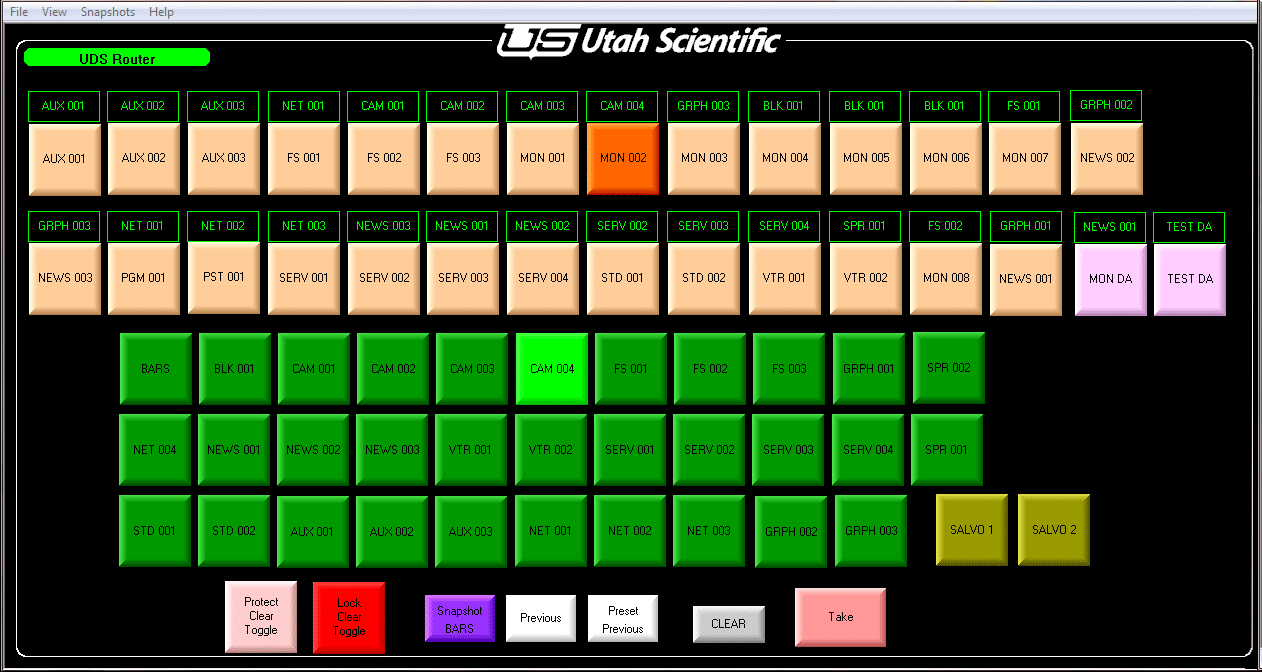
Over 12 UCP hardware panel models configure via drag-and-drop in Ucon software. Soft-LC provides a PC-based virtual panel with 16, 32, or 80 buttons; SoftPanel-2 allows full layout customization per user or location. The rMan tool monitors every card and power supply in real time.
UTAH-400 Series 2 — Full Specifications
| Standards | SMPTE 259M-C, SMPTE 292M, SMPTE 425M-A, SMPTE 425-B, SMPTE 310M, DVB-ASI |
| Formats | Auto-select; simultaneous SD, HD, 3G-SDI, 2K, DVB-ASI |
| Inputs / Outputs | 12 per card |
| Connector | Standard card: BNC | Hybrid card: HD-BNC and Ethernet port |
| Reclocking | Automatic at 270 Mbps, 1.485 Gbps, 2.970 Gbps, DVB-ASI; bypass for non-standard rates 3 Mbps–2.970 Gbps |
| Equalization | Auto 300 m @ 270 Mbps, 150 m @ 1.485 Gbps, 100 m @ 2.970 Gbps (Belden 1694A) |
| Signal Level | 800 mV p-p ±10% |
| Jitter | Conforms to SMPTE 259-C, 292M, 425-A, 425-B |
| Return Loss | <–15 dB to 1.5 GHz; –10 dB to 3 GHz |
| IP Standards | SMPTE ST 2022-6/8, SMPTE ST 2110 |
| SDI Inputs | 12 auto-detect 3G/HD/SD-SDI via HD-BNC |
| IP Outputs | 12 uncompressed ST 2022-6/8 or ST 2110; dual 40 GigE QSFP+; supports VLAN Tagging, IGMP, AMWA IS-04/IS-05/IS-06 |
| Network Ports | Dual 40 GigE SFP+, 10 GigE SFP, Ethernet for configuration |
| Standard | AES3id |
| Formats | 48 kHz, 16–24 bit, AES/EBU, AES-3 |
| Inputs / Outputs | 12 pairs per card |
| Connector | BNC unbalanced or D-SUB 37 balanced |
| Sample Rate | 48 kHz |
| Input Level | Min 200 mV p-p; Max 7 V p-p |
| Intrinsic Jitter | <0.025 UI Peak w/700 Hz HPF |
| Impedance | Unbalanced: 75 ohm | Balanced: 110 ohm |
| Modes | A-D and D-A stereo analog audio |
| Inputs / Outputs | 12 per card; Dual D-Sub 37 balanced |
| Frequency Response | 20 Hz–20 kHz ±0.05 dB |
| Max Input Level | 24 dBu |
| THD / IMD | 0.05% @ 24 dBu, 20–20 kHz |
| Hum and Noise | 0–15 kHz: –85 dBu |
| Common Mode Rejection | 70 dB @ 50/60 Hz |
| Standard | MADI/AES10 |
| Streams per Card | 3 MADI inputs; 3 MADI outputs (64 channels each) |
| Connector | BNC 75 ohm or optional SFP |
| Cable Length | 100 m with Belden 1694A or equivalent |
| Output Return Loss | <–15 dB to 125 MHz |
| AC Input | 90–240 VAC, 50/60 Hz (UL-listed, IEC950-approved) |
| Power per Frame | 72: 150 W | 144: 300 W | 288: 600 W | 528: 1,300 W | 1056: 2,600 W (max) |
| Width / Depth | 19" (48.26 cm) | 18.5" (47 cm) |
| Height per Frame | 72: 4-RU | 144: 7-RU | 288: 12-RU | 528: 20-RU | 1056: 40-RU (+ 1-RU PSU frame) |
| Operating Temperature | 50–104°F (10–40°C) |
| Humidity | 0–90%, non-condensing |
| Warranty | 10-year limited warranty, 24/7 service support |
Specifications are subject to change without notice.
What Broadcast Engineers Say
The UTAH-400 was a great choice for the upgrade. Not only does the router come with Utah Scientific's no-fee, 10-year warranty — unheard of in the broadcast industry — but it's based on a unique hybrid signal architecture that offers a single platform for all types of signals.
Based on our ongoing and successful partnership with Utah Scientific, we already have firsthand experience with the company's engineering excellence, product reliability, and first-rate service and support.
The first and most important element in our decision to renew was our current router's dependability. It ran 24/7, 365 for nine years, with no failures — no power supply failures, no control failures, no need to reboot.
10-Year No-Fee Hardware Warranty
Every UTAH-400 Series 2 router ships with Utah Scientific's 10-year no-fee hardware warranty and 24/7 service support. No annual maintenance contracts, no hidden renewal fees. The coverage is written into the product from day one — a direct reflection of the engineering confidence behind every chassis that leaves the factory.
For broadcast engineers who have watched other vendors' routers accumulate years of service contract costs, this warranty changes the total cost of ownership calculation entirely.
UTAH-400 Series 2 FAQ
Resources & Related Solutions
Spec sheets, pillar guides, and technical deep-dives to help you plan your UTAH-400 Series 2 deployment.
Hybrid SDI/IP Routing Solutions
A technical overview of how hybrid signal architectures handle simultaneous SDI and IP workflows — the foundation of the UTAH-400 Series 2 design.
Read the GuideBroadcast SDI Routing Solutions
Everything you need to evaluate SDI router architectures — frame sizes, I/O density, redundancy models, and control system integration for broadcast facilities.
Read the GuideUTAH-400 Series 2 Full Specifications
Complete technical specifications for all five frame sizes — digital video standards, audio formats, power requirements, physical dimensions, and module options.
Download PDFSMPTE ST 2110 & NMOS Control
A reference guide covering ST 2110 uncompressed media-over-IP transport and NMOS discovery and registration — directly relevant to PassThrough Card deployments.
Read the GuideBroadcast Signal Distribution Infrastructure
How to plan distribution infrastructure around a central router — fiber runs, coax, frame sync, and monitoring architecture for facilities of any scale.
Read the Guide24/7 Technical Service & Support
Utah Scientific's engineering and support teams are available around the clock. Every UTAH-400 Series 2 router ships with a 10-year no-fee hardware warranty as standard.
Contact SupportReady to Configure Your UTAH-400 Series 2?
Five frame sizes from 72×72 to 1056×1056, a full library of signal-processing modules, and a 10-year no-fee warranty. Talk to a Utah Scientific engineer to spec the right configuration for your facility.


